Ask whether he is hungry, and he may not answer. Ask where it hurts, what he wants or why he is crying, and no words arrive. Then sit him at a piano and listen as he reproduces a piece of music after hearing it once. Give him a date fifty years from now, and he may name the day of the week before your phone screen lights up.
What kind of mind can struggle with something most of us learn as children while doing something most of us could never learn at all?
We like ability to develop in an order that makes sense. We treat speech as proof of understanding and a recognizable response as evidence of awareness. When someone cannot show us what they know, we decide the knowledge is not there. When they do not react to an emotion in the expected way, we assume they never noticed the feeling in the room. Autism makes those conclusions far less certain.
The neurological differences that interfere with speech, social interpretation or flexible attention may sometimes sharpen perception, memory, concentration or pattern recognition. Some abilities leave evidence behind: a song, a calculation, a drawing made from memory. Others may exist beyond the reach of anyone watching.
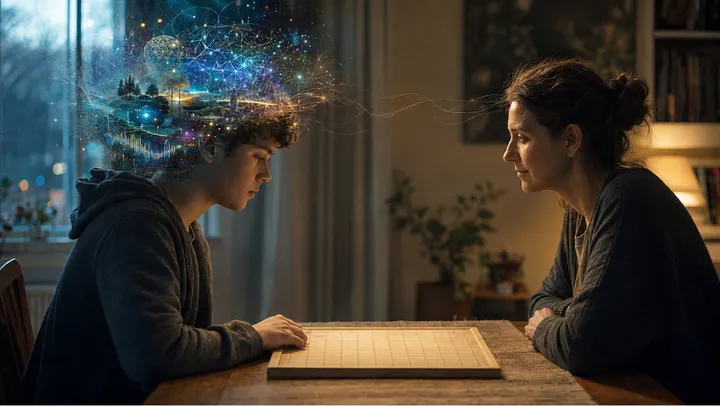
Some families believe even more is hidden there. They say their nonspeaking children do not merely understand conversations they appear disconnected from. Sometimes, they seem to answer a thought that never left another person’s mind.
What If We Have Been Looking at Autism Backward?
None of this makes autism any less disabling. Some autistic people cannot tell anyone where it hurts, calm a body overwhelmed by emotion or move safely through a world that can feel unbearably loud, bright and unpredictable. Relationships, education, employment and independent living may remain difficult throughout their lives. Some will always need help with basic needs. Calling every hardship a hidden gift would not be hopeful. It would be another way of looking past the person living with it.
But disability tells us where someone encounters limitations. It does not tell us everything that person’s mind may be doing.
We usually begin with what appears to be missing: eye contact, spontaneous speech, familiar social responses and flexibility. What happens if we reverse the question? If an autistic brain does not automatically prioritize the information most people notice first, where does its attention go instead? Could details, patterns or sensations that recede into the background for one person arrive with unusual force for another?
There is no evidence of a universal exchange in which the brain gives up speech or social ability and receives genius in return. Not every limitation conceals a talent. But neurological difference does not necessarily move in only one direction.
Perhaps autism does not simply turn certain functions down. In some people, it may turn others up. The same sensitivity that detects a note others miss may also make an ordinary room impossible to ignore.
When More Perception Creates More Difficulty
Some autistic people perform unusually well on visual searches, pitch discrimination and tasks involving fine sensory detail. The Enhanced Perceptual Functioning model grew from findings like these. An autistic brain may not be receiving less information. It may be preserving distinctions that other minds quickly blend together or discard.
Two nearly identical notes sound the same to most of us. A person with unusually precise hearing may detect the difference immediately. That sensitivity can be an advantage in music, but language depends partly on overlooking variation. A word must remain the same whether it is whispered, shouted or spoken in an unfamiliar accent. When every version arrives as distinct, recognizing them as the same word may become harder.
Vision can create a similar tension. Someone who spots the smallest change in an arrangement may see what everyone else missed while losing the larger pattern. More information also means more to manage. A crowded restaurant may not separate into one conversation and background noise. Every voice, scraping chair, flickering light and passing body may arrive at once, each demanding to be noticed.
Enhancement and impairment do not always come from opposite neurological differences. Sometimes they grow from the same one. The ear that can find a single wrong note in a song may be unable to escape a room full of sound.
Occasionally, that advantage produces something the world can hear, see or calculate for itself. When the ability becomes impossible to overlook, we call it savantism.
The Abilities We Can See
Savantism gives this unevenness a form the outside world can recognize. A person may need help buttoning a shirt yet possess a capacity almost no one else can match. This is more than intense interest or above-average talent. The skill rises far beyond either the general population or what the person’s functioning in other areas would seem to predict.
These abilities most often appear in music, art, mathematics, calendar calculation, mechanical reasoning or memory. Someone might reproduce a complicated composition after hearing it once, redraw a landscape in exact detail or identify the day of the week for a distant date almost instantly.
In a study of 137 autistic people, researchers identified savant skills through psychometric testing and parental reports. They appeared across a broad range of intellectual functioning, including among people with significant intellectual impairment. Human capacities do not always rise and fall together.
Most autistic people are not savants, and no one should be expected to reveal a hidden genius. Popular culture has turned rare cases into a familiar stereotype, as though disability becomes easier to accept when it arrives with a superpower. An autistic person’s value does not depend on an extraordinary performance.
Savantism, however, leaves something behind. A song can be recorded. A calculation can be checked. A drawing can be held in your hands. What happens when an enhancement leaves nothing an observer can hear, verify or touch?
Perhaps savant abilities are simply the ones that leave evidence behind.
The Abilities We May Be Missing
What can be performed is easy to believe. Hidden intelligence has no such advantage, especially when someone cannot respond in the way a test demands.
Traditional evaluations often rely on the very functions autism can disrupt. The person must follow spoken instructions, engage with an unfamiliar examiner, shift attention on command and coordinate an answer before time runs out. The mind may reach the answer while language or movement fails to deliver it. From across the table, that can look exactly like not knowing.
Studies comparing conventional intelligence tests with Raven’s Progressive Matrices, a largely nonverbal measure of abstract reasoning, have found that some autistic participants perform considerably better than their traditional IQ scores suggest. Minimally verbal autistic children may be especially vulnerable to being underestimated.
This does not mean every nonspeaking autistic person possesses typical intelligence or concealed genius. Replacing one assumption with another brings us no closer to the individual. It means that possessing an ability and being able to reveal it are not always the same.
Someone may remember conversations they appeared not to hear, recognize patterns they cannot explain or notice an emotional shift without showing it. An enhancement that cannot cross the bridge into observable behavior would look remarkably similar to no enhancement at all.
Parents who spend years learning a child’s smallest signals often notice what everyone else misses. Familiarity may explain much of that. Some families believe it cannot explain everything. They do not say only, “I know what my child is feeling.” They say, “My child knows what I am thinking.”
When Knowing Becomes Something Else
Most of us know the feeling of being understood before we speak. Long- married couples finish each other’s sentences. A parent senses trouble before a child explains it. A therapist hears one word land differently and knows the conversation has changed. Close friends recognize distress in a pause everyone else misses.
None of this requires telepathy. We read posture, breathing, timing, facial movement and tone without realizing it. Years spent close to someone can sharpen that awareness until a detail noticed without conscious thought feels like knowledge arriving from nowhere.
Some families of nonspeaking autistic people describe experiences that seem to go further. They report their children identifying private words, images or numbers they had no apparent way to know. Others recall a child reacting to a plan no one had mentioned aloud.
These are testimonial accounts, not scientific conclusions. Sincere testimony can give us a reason to investigate without telling us what caused the experience. Heightened sensitivity, years of unconscious pattern learning, coincidence, selective memory or unintended cues during supported communication could all play a role.
But perhaps some autistic people detect signals so faint that neither person recognizes how the information passed between them. Or perhaps something is happening that our current explanations cannot capture.
The Telepathy Tapes begins at that uncertain edge, where a thought never spoken appears, letter by letter, in someone else’s answer.
The Question Raised by The Telepathy Tapes
A number is chosen and kept from view. Across the room, a nonspeaking autistic person begins touching a board. One selection, then another. When the answer is complete, it matches. In another recording, the target is an image the participant has not been shown. Again, the answer appears to be correct.
Created by filmmaker Ky Dickens, The Telepathy Tapes builds its first season around moments like these. Parents describe children responding to thoughts no one spoke aloud. Some nonspeaking participants describe meeting one another in a shared place beyond the physical world, even while their bodies remain miles apart.
Nothing about the rooms feels extraordinary. These moments unfold at kitchen tables, on living room floors and beside letterboards held by parents who have waited years to know what their children might be thinking. Telepathy is not presented as a trick. It is presented as part of family life.
For those parents, the possibility means far more than one mind reaching another. It suggests that the person presumed unreachable had been listening, observing and connecting all along. Silence would no longer mean absence. It would become a wall with someone fully awake on the other side.
It is difficult to hear these families without wondering whether we have drawn the boundaries of the human mind too close to what the average mind can do.
But wonder is not proof. Neither is disbelief. The podcast offers testimony, observations and recorded demonstrations, not independently replicated research establishing telepathy among autistic people. That does not make the families dishonest or their experiences meaningless. It leaves the cause uncertain.
Before deciding whether someone received another person’s thoughts, we must determine who produced the answer.
When the Hand Beside the Letterboard Matters
The question of authorship becomes harder when another person is holding the board.
Many demonstrations of autistic telepathy involve a letterboard, keyboard or similar method with a communication partner nearby. That person may position the board, announce each letter or encourage the participant to continue. Influence can be almost invisible. The board tilts slightly toward one choice. A voice rises on another. A pause lasts a fraction too long. Neither person has to recognize the pattern for it to guide an answer.
This concern predates The Telepathy Tapes. Facilitated Communication has been studied for decades, and controlled tests have repeatedly found that facilitators can influence or produce messages without realizing it. The American Speech-Language-Hearing Association considers Facilitated Communication discredited and does not recommend Rapid Prompting Method because of prompt dependency and a lack of scientific validity.
None of that requires parents to be dishonest. They may be entirely sincere about what they have witnessed. Unconscious guidance is difficult to detect because it does not feel like guidance. What appears to be a clear answer may still leave us uncertain about whose knowledge produced it.
A meaningful test would choose targets randomly, block every ordinary way the participant might obtain them and keep anyone providing assistance from knowing the answer. Every attempt would count, including the misses. The results would need to rise well above chance and be repeated by independent researchers.
If someone continued identifying hidden information under those conditions, the finding would demand serious attention. Testing would not diminish it. Testing would allow the ability to stand on its own.
The purpose of skepticism should not be to close the door. It should be to make certain that whatever comes through it is real.
What If the Enhancement Has No Audience?
Some enhancements reveal themselves. A musician plays something thought impossible. An artist rebuilds a city on paper from memory. A calendar calculator supplies an answer that anyone can verify.
But what would heightened emotional sensitivity look like in someone who cannot describe an emotion? What would broad awareness look like when the body cannot produce a reliable response? How would we recognize an unfamiliar form of connection if we could not separate it from intuition, familiarity or coincidence?
Some experiences called telepathy may begin with extraordinary perception. An autistic person might preserve hundreds of details about someone’s breathing, expressions, voice and behavior, then recognize a pattern no one else can see. The answer may arrive instantly even if it was assembled from a thousand unnoticed pieces. That alone would represent a form of awareness most people do not possess.
But what if some of it is not that?
Scientific research has not established telepathy among autistic people under rigorous, repeatable conditions. The phenomenon may not exist. Existing research may also be insufficient to determine whether something unusual is occurring.
Curiosity cannot replace rigor. Unexplained does not mean supernatural, and moving testimony does not become proof. But a lack of proof should not become certainty that something is impossible.
The responsible position may be neither belief nor dismissal, but curiosity disciplined enough to survive either answer.
Maybe We Have Not Learned How to Look
He may still be unable to say where it hurts. He may still need help making it through the day. Then he reveals a memory, solves a problem or recognizes a pattern no one else could see, and the familiar order of human ability falls apart again.
Autism can create profound limitations while existing alongside unusual strengths in perception, memory or pattern recognition. Savantism shows that exceptional capacity can exist beside substantial disability. Nonverbal reasoning studies remind us that a test may measure how successfully someone can produce an answer without capturing everything the person understands.
Telepathy remains the unanswered part. Families believe they have experienced it, and The Telepathy Tapes has carried their stories far beyond their homes. The podcast has not established telepathy scientifically. It has made the question difficult to ignore and left research to determine what storytelling cannot.
Perhaps every such experience will eventually be explained by sensory sensitivity, pattern recognition, unconscious cues or the intimacy that develops between people who have spent years learning each other without words. Perhaps a few will resist every explanation we currently possess.
We already know that a mind can struggle with what most people find simple while doing what most people cannot do at all. Savant abilities may be the ones that happen to be visible. Others may remain inside, waiting for a language, a method or a science capable of finding them.
The autistic mind may not show us what it is doing in ways we recognize. That does not prove telepathy. It leaves us with a question worth asking: What if the limitation is not always in the mind before us, but sometimes in the way we have learned to look?
Sources
American Speech-Language-Hearing Association. “Facilitated Communication.” Position statement. 2018. https://www.asha.org/policy/ps2018-00352/.
American Speech-Language-Hearing Association. “Rapid Prompting Method.” Position statement. 2018. https://www.asha.org/policy/ps2018- 00351/.
Courchesne, Valérie, Andrée-Anne S. Meilleur, Marie-Pier Poulin-Lord, Michelle Dawson, and Isabelle Soulières. “Autistic Children at Risk of Being Underestimated: School-Based Pilot Study of a Strength-Informed Assessment.” Molecular Autism 6 (2015): 12. https://doi.org/10.1186/s13229- 015-0006–3.
Dickens, Ky, host. The Telepathy Tapes. Podcast. TTT Media, 2024 — . https://thetelepathytapes.com/podcast.
Eigsti, Inge-Marie, and Deborah A. Fein. “More Is Less: Pitch Discrimination and Language Delays in Children with Optimal Outcomes from Autism.” Autism Research 6, no. 6 (2013): 605 — 13. https://doi.org/10.1002/aur.1324.
Howlin, Patricia, Susan Goode, Jane Hutton, and Michael Rutter. “Savant Skills in Autism: Psychometric Approaches and Parental Reports.” Philosophical Transactions of the Royal Society B: Biological Sciences 364, no. 1522 (2009): 1359 — 67. https://doi.org/10.1098/rstb.2008.0328.
Mottron, Laurent, Michelle Dawson, Isabelle Soulières, Benedicte Hubert, and Jake Burack. “Enhanced Perceptual Functioning in Autism: An Update, and Eight Principles of Autistic Perception.” Journal of Autism and Developmental Disorders 36, no. 1 (2006): 27 — 43. https://doi.org/10.1007/s10803-005-0040–7.
Nader, Anne-Marie, Valérie Courchesne, Michelle Dawson, and Isabelle Soulières. “Does WISC-IV Underestimate the Intelligence of Autistic Children?” Journal of Autism and Developmental Disorders 46, no. 5 (2016): 1582 — 89. https://doi.org/10.1007/s10803-014-2270-z.